
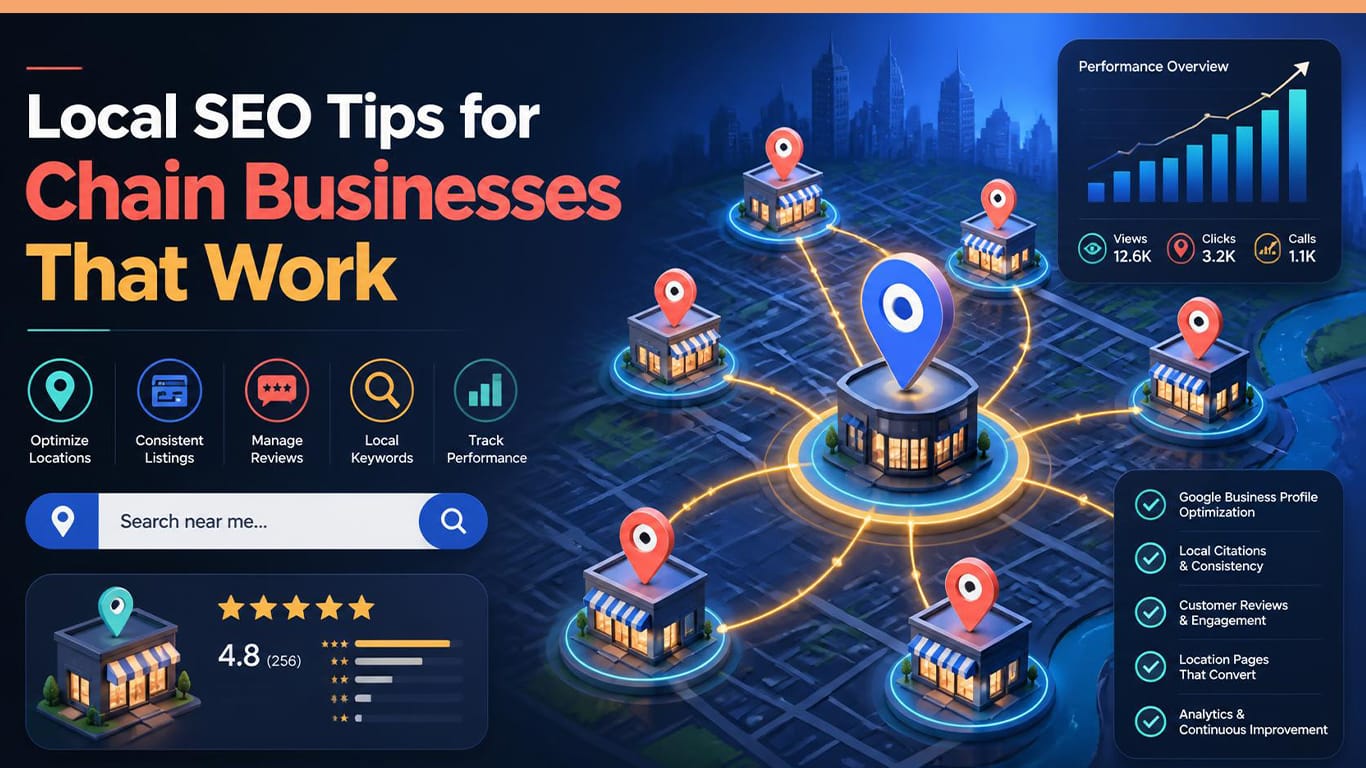
Local SEO Tips-If you manage local SEO for a chain business with several locations, it might feel overwhelming to keep up with so many digital profiles. But building a strong local search presence doesn’t have to be stressful.
To succeed in multiple markets in 2026, use proven, scalable local SEO strategies that work for every location. Whether you oversee five stores or five hundred, the right approach can boost your local visibility and help each market grow steadily. We’ve put together nine effective local SEO techniques for multi-location businesses.
These tips will help you attract more foot traffic and increase revenue everywhere you operate, from optimizing each Google Business Profile to keeping your brand consistent. If you want to stay ahead of your competitors and become the top choice in every local market, now is the time to put these strategies into action.
Key Points | Local SEO Tips
- For chain businesses, local SEO starts with optimising your Google Business Profile and ensuring Name, Address, Phone (NAP) details are consistent across all locations.
- Local businesses need local teams to manage location-specific content and reviews to achieve strong search visibility in every market.
- Improve your online visibility in a number of locations by using mobile-first optimization and obtaining local citations through business directories.
- By carrying out community engagement and location-specific keyword research, businesses can target local customers and satisfy their particular market needs.
- It efficiently scales local SEO activities using AI tools and at the same time keeps the brand messaging consistent from one location to another.
What does Chain Local SEO entail?
For chain businesses, local SEO is essential to build a strong digital presence across multiple locations; it is a form of search engine optimization aimed at increasing visibility in location-specific searches.
What’s Different About Local SEO for Chain Businesses
Local search optimization can be especially challenging for chain businesses. Unlike businesses with just one location, chains need to keep their brand message consistent across different local markets. The key is to balance brand standards with local adaptation.
Each location should compete well in its own market while still fitting in with the overall brand. This requires a strategy that combines general brand guidelines with local details.

Why Local SEO Matters Now More Than Ever
Currently, 46 % of all Google searches are local. Potential customers are searching for businesses near them.
This creates both opportunities and challenges for chain businesses:
- 76% of people who search nearby visit a business within 24 hours
- 28% of searches that are local result in a purchase
- 88% of consumers trust online reviews as much as personal recommendations
Key Factors to Local SEO Success
Here are some important elements of a strong local SEO strategy for chains:
- Location-based optimization
- Consistent Brand Message
- Development of local content
- Managing reviews
- Building citations
- Friendly mobile
All these factors help your business show up more in search results and bring more people to each location.
Why Local Search Has the Competitive Edge
Chain businesses that do local SEO well have a big advantage over competitors. They show up more often in local searches, attract more qualified leads, and build stronger connections with their communities.
The Importance of Local SEO for Multi-Location Businesses
In today’s digital environment, Local SEO is essential for businesses with multiple locations; each location should build a local presence while maintaining consistent branding.
Today, local SEO is key for multi-location businesses. Each location needs its own local presence, but the brand should stay consistent everywhere. Each location must appear in local search results when people search for a product or service in that area.
The Competitive Advantage | Local SEO Tips
Local businesses with strong local SEO often outperform bigger competitors in their own areas. They do this by targeting local audiences and building trust through personal interactions and community involvement.
Research shows that 46% of all searches on Google have local intent and that 88% of all consumers who perform a local search on their smartphone visit a related store within 24 hours. For chain businesses, this creates major opportunities across all locations.
local-search-patterns-insights-for-business-success-in-2025-pdffrom KHM Anwar

Factors That Affect Local Search Ranking
Google uses three factors to judge and rank businesses in local search. For chain businesses, understanding these components is key to improving local search visibility.
Relevance
Relevance refers to how well your business meets people’s needs, including the business category, the services you provide, and the keywords you target. For each location, the listing should reflect its specific services, and you should maintain high relevance scores.
Distance
Proximity to the searcher is a big factor in local rankings. Google considers the physical distance between the searcher’s location (or the location they specify in their search) and your business locations. This factor emphasizes the need for accurate address information for each location in your chain.
Exaltation-This factor covers your business’s overall reputation and how visible it is online and offline. Includes:
- Quantity and quality of reviews
- Citations on the web
- Backlinks from popular sites
- Social media footprint
- Total web presence
Each chain business has to secure a prominent position for its individual locations while at the same time keeping a consistent brand appearance and atmosphere over all of them.
Local Pack Exposure
At the top of the search results is the local pack, listing the three businesses that best match the search query. In order to obtain a position in this highly desirable spot, your business must perform well in all three ranking factors, together with the following:
- Business information that is accurate and complete
- Google Business Profile (Active)
- Positive customer review
- Nice pics and posts
5 Local SEO Tips for Chain Businesses
A good local SEO strategy for chain businesses uses a mix of proven tactics that work across all locations. Here are the key strategies that can help your business stand out in local search results in every market.
Base Your Online Presence: Begin by building a solid digital foundation for each location. Create and manage separate pages on your website for each location, and make sure each one has unique content that highlights its features and services.
Location-Specific Keywords: Add location-based keywords to your content naturally. For example, use phrases like “best coffee shop in [specific neighborhood]” instead of just “best coffee shop” to reach local searchers more effectively.
Establish Local Authority -Become the local authority in every market by:
- Be part of local business organizations
- Participation in community events
- Collaborating with other local businesses
- Sharing local news and updates
- Developing content that addresses local issues and interests
Best Practices for Technical SEO | Local SEO Tips
Focus on technicalities that increase local visibility:
- Accurate schema markup for each location
- Generate XML sitemaps for all location pages
- Include location-specific information in meta titles and descriptions
- Use canonical tags properly to avoid duplicate content
Brand Consistency
Localizing content is important, but make sure you keep brand consistency across all locations by:
- Consistency in brand messaging
- Adherence to corporate design guidelines
- Uniform Levels of Service
- Use of centralized content management systems
User Experience Matters
Improve user satisfaction on all location pages:
- Ensure that you load quickly
- Create intuitive navigation structures
- Make location-specific information easily accessible
- Include clear calls-to-action
- Optimize for mobile devices
Develop a Review Management Strategy | Local SEO Tips
Develop a standardized process for handling reviews at all locations:
- Review the reviews regularly
- Respond quickly to both positive and negative feedback
- Request reviews from satisfied customers
- Handle complaints in a professional and uniform manner
- Post positive reviews to social media
Build Local Content Hubs
Develop content hubs for each location, a comprehensive resource for local customers:
- Local calendars of events
- Promotions by zone
- Community News/Updates
- Services offered that are location-specific
- Pointing out local team members
- Make sure that each location’s Google Business Profile is optimized.
Local SEO Tips- If you run a chain business, optimizing your Google Business Profile (GBP) for each location is crucial for showing up in local search results. A complete, engaging profile for every location will help you attract more customers and boost local visibility.
Profile Components
- Correct company name, address, and telephone number
- Complete business description with unique offerings
- Primary and secondary business classifications
- Regular business hours and special holiday hours
- Quality photos of storefront, interior, and products
- Service area boundaries and delivery options
Tips to Optimize Your Photos
- Upload 10+ high-quality images per location
- Upload team photos for establishing confidence
- Demonstrate products and services in action
- Seasonal images updated regularly
- Add virtual tours where you can
Features of Engagement | Local SEO Tips
Leverage GBP capabilities to communicate with customers actively:
- Post weekly updates about deals and events
- Respond quickly to customer questions in the Q&A section
- Reply to reviews within 24-48 hours
- Announce company progress and achievements
1. Monthly Update Special Offers | Local SEO Tips
“Stay consistent with the brand but allow for each location to be unique and local.” Use the bulk management features in Google Business Profile Manager to update multiple locations effortlessly.
Handle Customers’ Reviews Carefully: Chain businesses need to manage customer reviews because they directly affect local search rankings and customers’ trust. Reviews provide social proof and can be the deciding factor for prospective customers.
Replying to Reviews: Respond to reviews in a consistent yet distinctive manner and please mention the names of the reviewers as well as reference specific points from their comments. This demonstrates that you care about your customers’ opinions and that you are engaged with your community.
2. Review Generation Techniques | Local SEO Tips
Train employees to ask for reviews at polite times after positive experiences
- Include review links in follow-up email
- Show QR codes in store that lead directly to review platforms
- Build a simple review funnel to make it easier for customers to leave reviews
Dealing with Negative Feedback: Respond promptly and professionally to negative reviews. Reply publicly to show your commitment to resolution but take the conversation offline when needed. This shows transparency and helps maintain your brand’s reputation across locations.
Monitoring Tools for Reviews: Keep an eye on the reviews using review monitoring software at all locations. This way you won’t fail to notice any feedback and will be able to maintain a consistent response time throughout your chain.
3. Produce Content That is Specific to A Location | Local SEO Tips
The most effective way to reach local audiences and improve search visibility for chains is to create location-specific content. Every location has unique features, consumer tastes, and community needs, and your content approach must reflect them.
Local SEO Tips | Custom Landing Pages
Build separate landing pages for each business location with locally relevant unique content. 4. Include details about the neighborhood, nearby landmarks, and local partnerships. This helps search engines understand each branch’s unique identity and gives potential customers valuable information.
Local SEO Tips | Local Events Coverage
Tell us about the various local events, festivals, and community initiatives that you’ve taken part in. Doing so will demonstrate your active involvement in the community and will help you build closer relationships with local customers. Don’t forget to tailor these posts to location-specific searches if you want to improve your visibility.
Local SEO Tips | Area Promotions
Write about local promotions, local deals, and local special offers. This increases engagement and signals to search engines that your content targets specific geographic areas. Be sure to refresh this content regularly so it stays current and relevant.
Local SEO Tips | Customer Success Cases
Include testimonials and success stories from local customers. Using this kind of website content helps to build trust and credibility, naturally features location-specific keywords, and provides social proof which appeals to potential customers in the area.
4. Set Up Local Citations and Enter Details in the Directory Listings | Local SEO Tips
Building a strong network of local citations and directory listings is essential to establish your chain business’s local authority. Every accurate citation is a vote of confidence for your business in Google’s eyes.
Why Local Citations Are Important
Local citations are trust signals that help search engines verify your business is legitimate in each location. Consistent business information across multiple authoritative directories helps improve your local search visibility and rankings.
- Must-Have Directory Platforms
- Google My Business Listing
- Bing Places for Business
- Apple Maps
- Yelp
- Yellow Pages
- BBB Better Business Bureau
- Directories for specific industries
Local SEO Tips | Best Practices for Building Citations
- Maintain NAP consistency across all platforms
- Give distinct descriptions for each location
- Add high-quality, specific photos for each branch
- Audit and refresh listings from time to time
Local SEO Tips | Remove duplicate listings quickly
Remember to focus on quality over quantity. A handful of accurate citations on trusted sites are better than many listings on low-quality directories, and they should be relevant to each location’s community. This covers:
- Websites of chambers of commerce
- Local trade associations
- Local business directories
- Forums –
- Local guides
5. Adopt Mobile-First Optimization | Local SEO Tips
For chain businesses aiming to succeed in local search, mobile optimization is essential. Since over 60% of searches happen on mobile devices, your website must work smoothly on every screen size’s
- Fast loading time (under 3 seconds)
- Buttons and links are easy to tap on
- Text readable without zoom
- Navigation menus made simple
- Correctly sized images and videos
Technical Aspects
Have your web developer use responsive design techniques so your site’s layout automatically adjusts to different screen sizes. Run your location pages through Google’s Mobile-Friendly Test tool to identify and fix any mobile usability issues.
- Tips for Speed Optimization
- Lossless image compression
- Reduce code and eliminate scripts that are not needed
- Use browser caching
- Use a content distribution network (CDN)
Core Web Vitals Optimization
Your online presence should be ready for users searching on the go. Make it easy for customers to find location details, make reservations, or contact your business quickly from their phones.
The key point is that mobile-first optimization is important for chains since it has a direct impact on local search visibility and on the user experience, with the two main areas to concentrate on being speed and accessibility.
6. Take Part in Community Activities | Local SEO Tips
Taking part in the community is a great way to boost your local SEO and build real connections with your audience. When your chain business joins local events, it becomes a valued part of each community.
Advantages of Community Engagement
- Enhanced local brand exposure
- Generates natural backlink opportunities
- Creates positive local media coverage
- Creates genuine customer relationships
Boosts mentions that improve local search rankings-Tactics for a Successful Community Event
- Sponsor local sports teams, cultural festivals
- Run charity fundraisers and donation drives
- Take part in neighborhood clean-up activities
- Conduct workshops or training sessions
- Support youth programs and local schools
Document these activities with photos and videos and post them on your Google Business Profile and social channels. This generates quality local content and demonstrates your dedication to community development.
Ask each location manager to find unique ways to engage with their local community. This approach ensures your activities are interesting and relevant to residents.
7. Carry Out Keyword Research that is Specific to the Location | Local SEO Tips
Location-based keyword research helps chain businesses understand and target customers’ unique search behaviors in different areas. Local search patterns can provide useful insight into what potential customers are looking for in specific locations.
Local search intent explained
Start with location-specific search terms that combine your business offerings with geographic modifiers. For instance, if you own a pizza chain, people may search for pizza delivery in [city name] or best pizzeria near [neighborhood]. These variations enable targeted content that speaks to local audiences.
- Local Keyword Research Tools
- Google Trends: Analyze regional search trends
- Google Keyword Planner: Refine keywords by location
- SEMrush: Compare keyword volumes between cities
- Arefs: Find a location’s long-tail keywords
Competitor analysis by place Local SEO Tips |
See which keywords your local competitors rank for in different markets. This helps you identify where you can outrank them and gaps in your keyword strategy.
Be sensitive to unique needs and preferences that may vary by region.
Use these location-based keywords naturally in your website content, meta descriptions, and Google Business Profile. This focus improves local visibility and attracts more qualified leads.
8. Make Sure That the NAP Information is Consistent | Local SEO Tips
Keep NAP (Name, Address, Phone number) consistent across all of your listings. Keeping your Name, Address, and Phone number (NAP) the same everywhere online is key for building trust with search engines and customers. Consistent business details show Google that your business is reliable and legitimate. Local SEO Tips
- Less confusion for the customer
- Improves local search results
- Prevents missed phone calls and missed opportunities
- Builds brand credibility
NAP Management Best Practices
- Use the same business name style
- Always include suite/unit numbers
- Standardize phone number format
All platforms are simultaneously updated to changes
Local SEO Tips | Check your citations for accuracy regularly
Make sure your NAP details are consistent on your website. Check that your NAP details match exactly on your website, Google Business Profile, social media, and business directories. Even small differences, like writing Street instead of St., can affect your local search rankings’ that includes the correct NAP info for each location. This master document helps keep things consistent when updating multiple business listings or creating new citations.
- Monitoring Tools for NAP
- Moz Local
- Bright Local
- Yext
Local SEO Tips | SEMrush Listing Management Software
The key point is that it is essential to have consistent NAP data on all digital channels if you are to achieve success with local SEO and to build credibility with both search engines and customers.
9. Using AI Tools to Scale | Local SEO Tips
Many chain businesses now use AI tools to manage local SEO across multiple locations. These tools help you create content faster, automate routine tasks, and keep your local SEO strategy consistent everywhere.
Content Creation– Location-specific content can be created in bulk using AI writing tools. Tools like Jasper, write sonic, and Copy.ai are popular options that can help generate unique descriptions, meta tags, and blog posts for each site while keeping your messaging on brand. These solutions save many hours that would otherwise be spent manually creating content for each branch.
Automated Review Handling– Smart AI systems examine and keep an eye on reviews for all locations and customers, allowing you to be warned about negative feedback so that you can deal with it right away and helping you to create customized response templates in order that you may promptly reply to customers and keep a consistent brand voice.
Analysis and Reporting of Data– Advanced AI tools can comb through massive amounts of local SEO data to uncover trends and opportunities. Monitor performance indicators by location, analyze competitor strategies, and use the insights to improve your local search rankings.
Best Practices in Multi-Location Management– To deal with business locations at various sites it is necessary to have a strategic plan to make sure that consistency is maintained while at the same time adapting to the requirements of the local market. Here is how successful chain businesses successfully overcome this problem:
Local SEO Tips | Brand Guidelines – Centralized
Set clear brand guidelines that all locations must adhere to. This means your brand voice, visual identity, and customer experience remain consistent across all outlets. Create a thorough document covering everything from logo use to customer service.
Local Market Customization
Let each location adapt to its local market while maintaining brand consistency. This means:
- Tailoring promotions for local events
- Tailoring pricing strategies for various markets
- Services tailored to the needs of specific communities
- Localizing marketing messages to fit local audiences
Fundamentals of Communication Systems– Create solid communication channels between headquarters and individual locations:
- Regular virtual meetings with location managers
- Centralized digital platforms for dissemination of updates
- Standardization of reporting systems
- Clear escalation path fr issues
Quality Control Programs–Create comprehensive quality control procedures:
- Routine audits of each location
- Secret shopper schemes
- Analysis of client feedback
- Location-based performance benchmarking
- Employ centralized management software
- Establish tools to produce automated reports
- Install inventory control systems
Technology Integration– Use technology to improve your operations:
Use Customer Relationship Management Platforms
As your business grows and markets change, review and update these practices regularly. This will help your chain stay competitive and keep delivering value at every location.
(Important point: Successfully operating multiple locations demands a balance between brand consistency and local market adaptation, supported by robust communication systems and technology integration.)
Measuring Local SEO Success by Location
Measuring local SEO success means being systematic across multiple locations to ensure your chain business performs consistently. Tracking the right metrics helps you see where you need to improve and whether your local SEO is working.
Local SEO Tips | Important Metrics to Track
Keeping track of these important metrics will give you valuable insight into how well your local SEO strategy is working:
- Rankings for location-specific keywords in search visibility
- Local search click-through rates
- Conversion rate by location
- Count of “Get Directions” clicks
- Tracking data from phone calls
- Local Pack Rankings
- Location-Based Analytics
User Engagement by Location
Track each location’s performance individually to see market-specific trends. Create location-specific Google Analytics properties for tracking:
- Performance of local landing pages
- Ratio of mobile vs desktop traffic
- Regional trends in usage behavior
Performance Tracking Review
Reviews play a vital role in achieving success with local SEO. Be aware of these review-related metrics:
- Ratings by location (average)
- Look at response rate and response time
- Analyze review sentiment
- Volume growth review
- Check performance on some platforms
Competitive Benchmarking
See How You Compete with Close Competitors:
- Local pack ranking spots
- Ratings and volume review
- Interaction with content
- Local citation consistency
- Social media presence
Local SEO Tips | Monitoring of Metrics for Performance
To track your local SEO performance in a number of locations you need to systematically monitor the key metrics, so that you can tell what is working and what requires improvement.
Important Metrics to Track
- Click-through rates for local searches
- Conversion rates per location
- Positions of target keywords in the Local Pack
- Visibility scores for each location
- Levels of client engagement by branch
Google Business Profile Insights
Track profile views, requests for directions, and phone calls for every location. These metrics show how well your locations perform in local searches and drive customer actions. Analytics of website by location
Local SEO Tips | Track landing page performance by location with:
- bounce rate
- Time on page
- Pages/session
- Completions
Mobile vs. Desktop Traffic
Mobile traffic refers to users who access a website or app from a smartphone or tablet. Desktop traffic comes from users on a laptop or desktop computer. Over the past decade, mobile traffic has increased a lot.
In some industries, it now makes up more than half of total website visits. Desktop traffic still remains important, especially for tasks that need a bigger screen or more processing power. Marketers and designers need to consider both types of traffic when they build websites or services. This helps make sure they work well for everyone.
Local SEO Tips | Performance Review Follow-up-Keep track of:
- Location average rating
- Examine response rates
- Review of sentiment analysis
- How often to review
Local SEO Tips | Themes of client feedback
Monitor these metrics regularly to maintain strong search visibility, a clear site structure, and a consistent focus across all your locations.
Local SEO Tips | Advanced Local Search Methods
Local search is changing very quickly, and chain businesses need to put into place more advanced strategies if they are to keep up.
The following are some methods by which you can improve your local SEO:
Local SEO Tips | Use Voice Search Optimization
With the rise of smart speakers and voice assistants, optimizing for voice search is more important than ever. Focus on natural language patterns and long-tail keywords people use in conversation. For example, instead of “pizza restaurant Chicago,” you would optimize for “where’s the best pizza restaurant near me?”
Local SEO Tips | Implement Local Schema Markup
Schema markup helps search engines better understand your business information. Add location-specific schema to each store page like:
- Opening times
- Forms of payment accepted
- Department-specific information
- Special services or offerings
- Availability of parking
- Delivery range
Local SEO Tips | Use Local Link Building-Generate location-specific backlinks with:
- Supporting local events
- Working with local businesses
- Helping out at local news sites
- Working on community projects
- Assisting local charities
Local SEO Tips | Utilize Content created by users-Encourage your customers to create content about your venues:
- Photography contests
- Tagged social media posts by location
- Success stories of our customers
- Collaborations with local influencers
Local SEO Tips | Create Location-Specific Landing Pages– Create fresh, relevant content for each location page:
- Promotions by Region
- Local Team Member Spotlights
- Community engagement strategies
- Contextual Services
- References to local attractions
Local SEO Tips | Utilize Predictive Analytics– Leverage AI-enabled tools to:
- Project seasonal trends
- Know how potential customers will behave
- Location-based inventory optimization
- Tailor local marketing efforts
- Monitor competitors’ activity
Local SEO Tips | Prioritize Local Social Proof– Establish credibility with local social proof:
- Employee Highlights
- Testimonials from local customers
- Case studies in particular locations
- Stories of community impact
- Local Awards & Recognition
Summary-Local SEO Tips
As you begin your Starting your local SEO journey as a chain business takes steady effort and a willingness to adapt. By using these nine proven strategies, you’ll be set to succeed in multiple markets in 2026 and beyond.
From optimizing your Google Business Profiles to using AI tools, each step boosts local visibility and attracts customers to every location. Keep tracking your results and adjust your approach as needed. With dedication and the right tactics, your chain can become the top choice in every local market.
Start using these tips today and watch your local search rankings rise, bringing more visitors and revenue to each location. The future of your chain’s local SEO success starts now—are you ready to lead?
How Long Until Chain Businesses Notice the Results from Local SEO?
Results can vary widely, depending on market competition and the way the strategy is implemented. To help you plan and set realistic expectations, here are typical milestones for a chain business investing in local SEO:
Local SEO Tips | Month 1: Initial groundwork, such as updating Google Business Profiles, correcting citations, auditing NAP consistency, and optimizing priority location pages. You may see early signs of increased visibility, but major changes are unlikely yet.
Local SEO Tips | Month 3: Early improvements begin to show, such as increased impressions in local search, more reviews coming in, and better accuracy and consistency across listings. Some locations may start moving up in search rankings and receiving slightly more organic traffic.
Local SEO Tips | Month 6: Noticeable advancement in local search rankings for key terms, higher engagement with local content, and a steady growth in website traffic and calls from local searchers. Locations often appear more frequently in the Local Pack and start seeing a measurable increase in leads.
Local SEO Tips | Month 12: Strong market position with significant increases in local rankings, organic leads, and revenue. Established brand consistency across all locations, robust review profiles, and streamlined local SEO operations. At this stage, chain businesses can approach market dominance in their local areas if efforts have remained consistent.
Local SEO Tips | Most chain businesses can expect a significant improvement in local search rankings within 3-6 months of consistent effort. But big results and market dominance typically require 6-12 months of dedicated optimization.
How much should I expect to spend on local SEO for multiple locations?
A good rule of thumb is to set aside 20-30% of your total marketing budget for local SEO initiatives. For chain businesses, this can range from $500 to $ 2,000 per location per month, depending on market competitiveness and business size. To help you plan and justify your spend, here is a sample budget allocation that can be adjusted based on your needs:
- Content creation and optimization: 40% (blog posts, landing pages, location-specific updates)
- Citation and directory management: 20% (auditing, building, and maintaining listings)
- Review management and reputation monitoring: 15%
- Local SEO tools and software: 15% (for tracking rankings, managing listings, competitor analysis)
- Community engagement and link building: 10% (sponsorships, local partnerships, events)
Focusing on these high-value activities can help ensure that your budget delivers measurable results and supports sustainable local SEO growth across all your locations.
Local SEO Tips | How do chain businesses maintain brand consistency while optimizing for different locations?
Develop a comprehensive brand guideline document with approved messaging, visual elements, and content templates. You can tailor within these parameters on a location-by-location basis. Use a content management system that allows for both standardization and local personalization.
Local SEO Tips | What are the common issues encountered when working on local SEO for multiple locations simultaneously?
Some key challenges include: Maintaining NAP consistency across all locations, efficiently scaling content creation, managing multiple Google Business Profiles, coordinating local team efforts, and effectively tracking performance indicators across different locations
Local SEO Tips | How often should chain businesses revisit their local SEO strategy?
Quarterly: Review and Update Your Local SEO strategy. Monthly: Monitor performance measures and react quickly to changes in algorithms, market conditions, or competitor behavior. Review the strategy annually to ensure it aligns with business growth objectives.
Local SEO Tips | Can chain businesses use the same content on multiple location pages?
It’s also okay to include some core content. Still, each location page should include at least 30-40% unique content focused on local elements, community engagement, unique services, and location-specific promotions. This helps to avoid duplicate content issues and improves local relevance.
FAQs for “9 Local SEO Tips for Chain Businesses That Work: Crush Multiple Markets”
What is local SEO, and why is it important for chain businesses?
Local SEO focuses on optimizing your online presence to attract more business from relevant local searches. For chain businesses, it helps ensure that each location can effectively compete in its respective market.
How can I optimize my Google My Business listing for each location?
Ensure each location has its own Google My Business profile with accurate address, hours, photos, and services. Encourage reviews and respond to them to enhance engagement and visibility.
Should every location have its dedicated webpage?
Yes! Each location should have a unique webpage with locally relevant content, including location-specific keywords, services, and customer testimonials to improve search rankings.
How important are local citations for chain businesses?
Local citations are crucial as they help establish credibility and improve local search visibility. Ensure your business information is consistent across platforms like Yelp, Yellow Pages, and local directories.
What role do customer reviews play in local SEO?
Customer reviews enhance trustworthiness and can significantly impact local rankings. Encourage satisfied customers to leave reviews and manage any negative feedback promptly and professionally.