
Are you ready to claim your corner of the global market in 2025? International SEO is the secret weapon that can turn your neighborhood shop into an international brand. Today, customers move freely across borders, and sticking to one market can leave money on the table. Brands that nail international SEO report 70% or more growth in organic traffic from countries they’d never considered. The hitch? Local SEO hacks don’t always work on an international scale.
That’s why we’ve put together 7 hard-earned international SEO tactics that will kick your local search rankings into overdrive, no matter where your customers hang out. From untangling the hreflang mess to making your content feel local in every target market, we’ll cover the landmines and the shortcuts.
Inside, you’ll find the technical insight and the cultural finesse you need to build an international SEO machine that pays off in every place you want to sell. Let’s jump into the tactics that tomorrow’s global winners are using today.
Key Takeaways
International SEO takes local SEO to the next level by tuning into different countries, languages, and cultural vibes while sticking to best practices that search engines love.
Technical Building Blocks
Getting the technical stuff right sets the stage for everything else. Make sure you’ve got hreflang tags that point users to the right language and region. Choose domain structures that fit your business model and make content delivery fast, no matter where the user is. These elements work together to keep your site fast and users happy.
Landing Pages and Profiles
For each key market, create landing pages that speak directly to the local audience. Pair that with well-optimized Google Business Profiles for every city or region you serve. This local focus signals to search engines that you’re serious about each market, helping you show up in location-based search results.
Content that Connects
Translation isn’t enough. Go deeper by researching local phrases that resonate and adapting your messaging for cultural nuances. Ensure that each piece of content is in the local language and that it feels natural to native speakers. This is where research, creativity, and language skills come together.
Building Local Authority
Claim your business in local directories to create strong citations. Respond to reviews consistently and create content that links your brand to local events, news, or traditions. These actions build trust and show search engines that you’re an established player in each market you serve.
Ongoing Measurement
Finally, keep an eye on the data. Use separate views or tags to track performance by region, and check local search results, ranking changes, and traffic patterns. This ongoing measurement lets you see what’s working and what needs a tweak in each market.
Putting it All Together
International SEO and local search, while different, work hand in hand for digital growth. Master the technical side, optimize for each market, and keep measuring the results. When you do, you create a strong foundation that supports successful global and local reach.
This method empowers companies to overcome language differences and cultural gaps so they can genuinely reach customers around the world.
Understanding Local Search
Local search optimization focuses on specific areas, making sure your business appears when someone searches for your products or services nearby. This is critical since 46% of all Google searches now have local intent. Local SEO gets you noticed when potential customers in your region need what you offer.
Key Pieces of Search Engine Optimization
The backbone of both international and local SEO rests on a few essential parts:
- Clean website structure and technical setup
- Content that is both relevant and high-quality
- User experience fine-tuned for each region
- Mobile-friendliness
- Fast loading speeds
- Accurate local business listings and citations
How International and Local SEO Work Together
When you put international SEO and local search strategies in place, they fuel one another to:
- Boost your global reach while keeping local focus
- Forge stronger ties with your target markets
- Climb search rankings in many areas
- Attract qualified visitors from different locations
- Lift conversion rates through tailored local experiences
How International and Local SEO Differ
Even though both methods strive to get you noticed, they each work toward different goals and call for unique tactics.
International SEO vs. Local SEO: What’s the Difference?
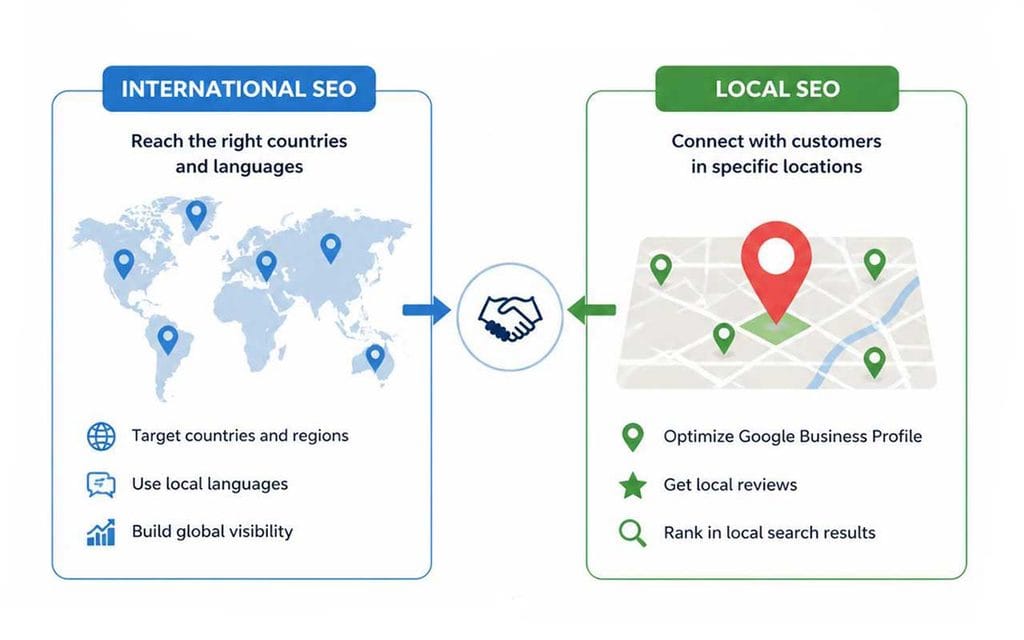
International SEO is all about reaching people in different countries and languages. This means you have to think about cultural differences, how languages change, and even which search engines people in each country prefer. You’ll need to get a URL structure, hreflang tags, and localized content just right to make sure the right people see the right information.
Local SEO, in contrast, zooms in on a specific area, usually within one country. You optimize for “near me” searches, make sure your business listings include the right city or state, and build citations in local directories. The goal is to show up in local map packs and attract customers who are right in your service zone.
The main difference is in how wide your reach and tech setup have to be. Local SEO mostly pays attention to NAP (name, address, phone number) consistency and a strong Google Business Profile, while international SEO needs more complicated URL setups and careful language targeting.
Why You Need a Global SEO Plan
A strong international SEO plan is a must for any business that wants to grow beyond its home country. When you map your global strategy, you can reach many different groups while keeping your brand message the same everywhere.
The Case for Global SEO
The online marketplace doesn’t have borders. Since 63% of searches are in languages other than English, a strong international SEO strategy isn’t just a nice-to-have anymore. It’s a key part of growing in a smart, lasting way.
A smart global SEO plan makes it possible for you to:
- Tap into fresh markets without wasting energy
- Earn trust and authority for your brand overseas
- Draw in qualified leads from all corners of the world
- Outpace competitors no matter where they’re based
- Forge real connections with local customers

Benefits of Going Global with SEO
When you roll out a thorough international SEO plan, here’s what you can expect:
- Bigger ReachCatch new markets before competitors even notice they’re there.
- Brand RecognitionMake your brand a name people know all over the globe.
- Stronger ROICraft local content that speaks the language and converts visitors into customers.
- Winning EdgeMake your site impossible to ignore with region-specific optimization.
- Happy UsersServe up content that feels tailor-made for local audiences.
Smart Planning Steps
Crafting your global SEO strategy? Keep these points in mind:
- Dig into cultural differences and respect them.
- Shape your content around what local people really want to see.
- Keep your brand voice the same, no matter the language.
- Stick to the SEO rules that matter in each region.
- Keep watching and fine-tuning your approach.
Play it smart by matching your international SEO work with your larger business goals while still paying attention to what every local market and its users really want.
Start with Market Analysis
Market research and careful planning lay the foundation for your global SEO success.
Before you jump into optimizing performance, take the time to really grasp how each market you want to reach operates.
Research Your Target Markets
Begin by sizing up different countries and regions. Check how big the market is, how many players are already there, and where the growth is. Pay special attention to these points:
- Rates of internet access
- Which search engines are popular there
- How many users are on mobile vs. desktop
- Shopping habits and preferences
- Local laws and compliance rules
Competitor Analysis
Keep an eye on the brands already winning in those countries:
- Break down how their site is set up and their content plan
- Look at the keywords they are going after
- Check how they are gathering local backlinks
- Analyze their social media activity
- Spot any gaps in their approach you can take advantage of them
Cultural Considerations
Culture changes how people respond to online content, so you need to pay attention:
- Which colors are popular and what they symbolize
- How formal or casual communication is
- How and when people decide to buy
- Which payment options are preferred
- Which social media platforms do people actually use
Resource Assessment
Take stock of what you have to work with:
- How much budget can you assign to each market
- The technology and infrastructure already in place
- How will you create and translate content
- Local partnerships you can tap into
- Support staff who can work in different time zones
Once you have all this information, rank the markets by expected return on investment and how well you can deliver what they need. That way, you can put your energy where it will pay off the most.
This focused strategy makes sure your worldwide SEO work zeroes in on the brightest growth chances.
Knowing Your Target Markets
Learning about each target market is the first step to making your international SEO sing. Every region varies in tastes, online habits, and local quirks, so you’ll need to adjust your optimization plan accordingly.
Cultural Signals
Cultures bring their own values and expectations. For instance, while clear and bold calls-to-action connect in the U.S., Japanese audiences often respond better to softer, relationship-driven messages. Pay close attention to these differences when you write and plan campaigns.
User Behavior Tracking
Watch how your target customers engage online. In some markets, mobile carts rule; in others, desktop rules the day. Knowing these patterns lets you design navigation, checkout, and checkout flows that feel natural and familiar to each audience.
Local Competition Check
Every market plays by its own competitive rules. Dig into local rivals to spot:
- What they do well and where they stumble
- Content holes you can peacefully fill
- Unique offers that hit home with local buyers
- Channels they’ve locked down and that you should consider
Market-Specific Hurdles
Write down any hurdles that could trip you up in each region, like:
- Language differences
- Local legal requirements
- Technical quirks of the local internet
- Preferred payment methods
- Shipping and logistics limits
Technical Foundation for Global SEO
Lastly, a sturdy technical base is non-negotiable. When your site’s architecture, speed, and mobile responsiveness are solid, you can confidently expand into multiple regions without service lag or errors.
A clear technical setup not only makes it easier for users to get around your site but also helps search engines crawl and index your content effectively across different countries and languages.
Website Architecture
Your site should be built to grow. Plan a layout that lets you add new languages and regions without starting over. Use a clear folder structure that guides users from one language to another. Consider a content delivery network (CDN) to speed up delivery, no matter where your audience is located.
Hreflang Tags
Getting hreflang tags right is key to International SEO. These little bits of code tell search engines the language of a page and the regions it should show. Keep these points in mind:
- Use both language and country codes (like en-US for the U.S. and en-GB for the U.K.)
- Always add self-referential tags for each language version
- Make sure language versions link back to each other
- Keep the tags in the HTML head of the page
Technical SEO Checklist
To keep the technical side sturdy:
- Set up geo targeting in Google Search Console
- Create country-specific XML sitemaps
- Design clear URL structures for each region
- Make sure all versions of the site work well on mobile
- Improve page speed for each target market
- Apply structured data that fits each region
Server Configuration
Your server setup is key to winning at international SEO:
- Pick server locations that match your target markets.
- Make sure IP detection and redirection work right.
- Set up SSL certificates for each country.
- Use smart caching to speed up site delivery.
- Always go with UTF-8 for character encoding.
Schedule regular audits of your setup to catch and fix issues that could hurt your international SEO.
Big idea: A strong tech base—including correct hreflang tags, a well-structured site, and a powerful server—is the backbone of great international SEO.
Choosing the Right Domain Structure
The way you set up your domain is key to international SEO. You usually have three main options, each with pros and cons.
Country Code Top-Level Domains (ccTLDs)
Using a unique ccTLD for each country (like .uk, .de, or .fr) gives you the best geo-targeting. Search engines trust these domains, and local users see their country’s extension and feel at home. Still, ccTLDs take a lot of upkeep and can be pricey to roll out in several markets.
Subdomain Structure
Country or language-specific subdomains (uk.website.com, de.website.com) strike a good balance. You still get decent geo-targeting without the overhead of ccTLDs. You can re-use some of the main domain’s resources, which saves time and money.
This setup keeps your main domain on top while letting you host and manage region-specific content more easily.
Subfolder Structure
Going with subfolders (website.com/uk/, website.com/de/) is the cheapest and quickest route. It parks all your SEO juice under one roof and makes upkeep simple. It won’t send as strong a local signal as country-code top-level domains (ccTLDs), but if you use hreflang tags correctly, you can clearly signal which region you’re targeting.
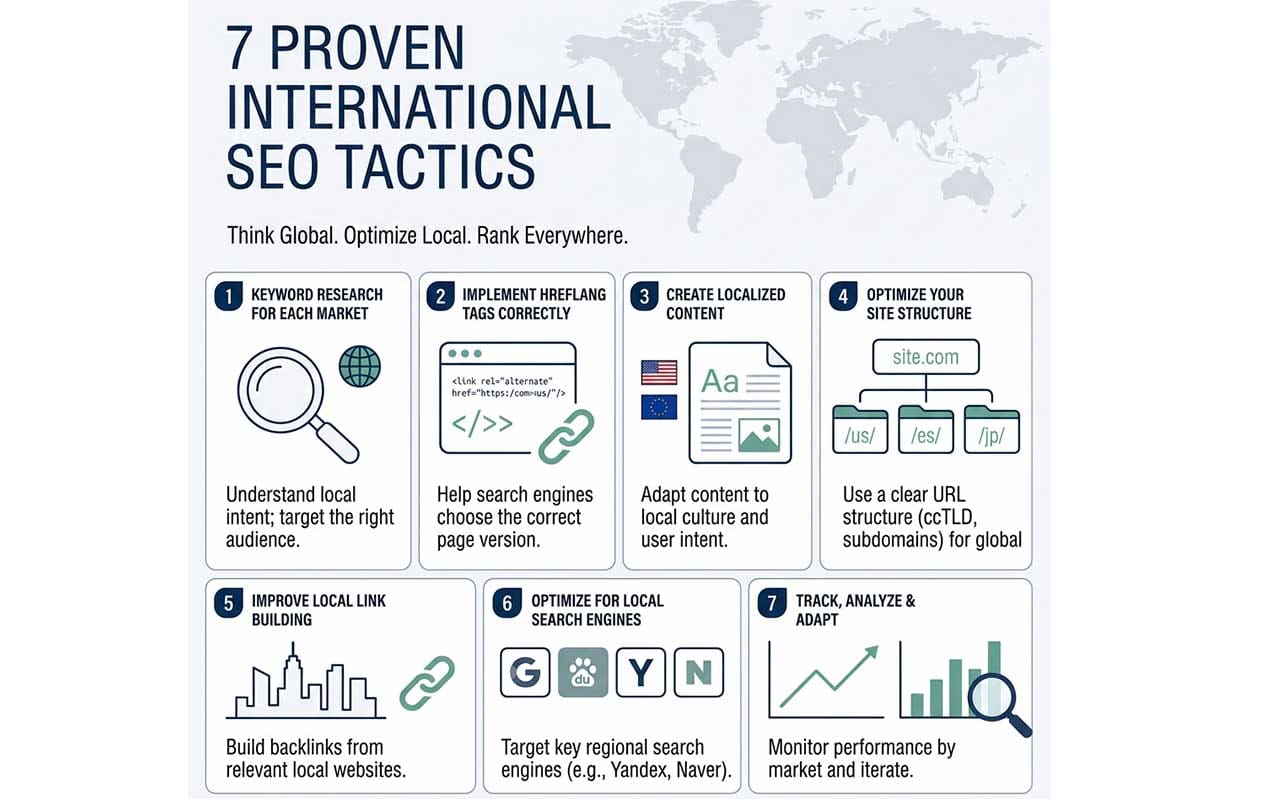
7 Proven International SEO Tactics
Winning at international SEO takes a smart mix of tech know-how and cultural insight. Here are seven solid tactics to help your business grab local search rankings in every market you enter.
Optimize Google Business Profile for Multiple Locations
Keeping Google Business Profiles for all locations accurate and complete is a must. Make sure your NAP (Name, Address, Phone number) data is the same everywhere. Upload sharp photos, write tailored business descriptions, and include operating hours for each site. Post updates, promotions, and events regularly to show Google you’re on the ball.
Choose business categories that are spot-on for each location. Answer customer reviews—good or bad—quickly and courteously to show the local crowd you care.
(Key takeaway: A well-optimized Google Business Profile for every location boosts your visibility in local searches and fosters trust with potential buyers.)
Build Location-Specific Landing Pages
Make distinct local web pages for every market or area you serve. These pages need to include:
- Location-specific keywords seamlessly placed in the text
- Thorough details about the services or products offered there
- Local contact information and clear directions
- Reviews and testimonials from customers in that area
- High-resolution images showing your presence there
Keep each page original by avoiding duplicate content. Customize it with fresh, location-relevant details.
(Key takeaway: Unique local pages signal to search engines that you operate in specific areas, and they deliver helpful information to local customers.)
Set Up a Multi-Language Content Plan
Produce content in the native languages of every market you target. This includes:
- Using professional translation services for accuracy
- Adapting content culturally (transcreation)
- Correctly applying hreflang tags
- Using images and examples relevant to that region
- Crafting a culturally sensitive content strategy
Stay aware of local holidays, customs, and preferences throughout the process.
(Key takeaway: A well-implemented multi-language strategy keeps your content relevant to local audiences without harming its SEO impact.)
Build Local Citations and Gather Reviews
Prioritize creating a robust citation profile for each market:
- Add your business to local directories
- Keep your Name, Address, and Phone number the same everywhere
- Ask happy customers to write online reviews
- Check and reply to reviews on every platform
- Handle negative reviews calmly and professionally
Use specific directories that cater to your industry and the regions you serve.
Strong local citations and regular review management boost your visibility and build trust in local searches.
Research Region-Specific Keywords
Dive deep into keyword research for every new market you enter:
- Find key phrases that include your location
- Look for shifting local search trends
- Study competing businesses’ keywords
- Note any differences in local dialect
- Zero in on long-tail keywords that include location
Use keyword research tools focused on local data and talk to locals for the best phrases.
Tailor-made keyword research matches your content to what local people actually search for.
Build a Local Content Marketing Plan
Craft content that genuinely speaks to your local audience:
- Report on neighborhood news and events
- Show your business giving back to the community
- Make location-based posts on social media
- Team up with local social media influencers
- Share stories of local customers who succeeded with you
Local content marketing forges community ties and helps your business rank higher in specific areas.
Track Regional Search Performance
Measure how your local visibility changes in each market:
- Keep an eye on organic search rankings
- Check your position in Google’s Map Pack
- Watch how local keywords are performing
- Measure organic traffic by region
- Review conversion rates by location
Key takeaway: Regular performance monitoring uncovers opportunities for growth and confirms that your strategy is on track.
Key takeaway: These seven tested tactics create a complete plan for international SEO, enabling businesses to build a strong local presence in many markets.
Optimize Google Business Profile for Each Location
Setting up your Google Business Profile (GBP) for every location is a must for international SEO. Each site needs its own, fully optimized profile to rank well in local search results.
Key Elements for GBP Optimization
Begin by verifying each profile to prove you own that location. Make sure every profile lists complete and accurate details, including:
- Business name
- Address
- Business hours
- Primary phone number
- Business category
- High-resolution photos
- Service area
Managing Many Locations
In your GBP dashboard, create a location group to handle multiple profiles easily. This central tool keeps information consistent while letting you tweak details for each region.
Always keep your NAP (Name, Address, Phone) the same on every profile. A small mistake anywhere can confuse search engines and customers, which can drag down your local rankings.
Profile Engagement Strategy
Stay active on your profiles by:
1. Keep Google Business Profiles Active
Make sure every location keeps its Google Business Profile up to date.
- Respond to customer reviews right away. Even a quick “Thanks for the feedback!” makes a difference.
- Post regular updates about each store—in-store changes, events, and even minor tidbits.
- Share special offers that only apply to that location so local customers feel like VIPs.
- Add fresh photos every month to show the store, staff, and any new displays.
- Update holiday hours well in advance so customers aren’t surprised.
Key takeaway: A fully optimized Google Business Profile at each site, with accurate info and lively engagement, is a must for winning at international SEO.
2. Launch Location-Specific Landing Pages
If you serve customers in different regions, location-specific landing pages are a no-brainer. These pages act like mini homepages for every place you operate.
Why They Matter
Search engines look for signals that tell them where you do business, and so do customers. A well-made local page makes it clear to both.
Key Elements to Include
- Original content that speaks directly to local needs and interests.
- Local business phone number and hours of operation.
- Customer testimonials or case studies from that area.
- An embedded Google Map and clear directions.
- Region-specific offers or highlight promotions.
- Profiles and photos of team members from each location.
- Details about services or products unique to that region.
Best Practices
- Never repeat the same content from one page to another; that only confuses search engines.
- Sprinkle in local keywords—place names, neighborhoods, and zip codes—in titles, headers, and throughout the text, but only where it reads naturally.
- Add schema markup to clarify your location info for search engines. It tells them exactly where you are and helps your business appear on maps and local search results.
- Make sure your website looks good and works fast on mobile devices. A mobile-friendly design keeps users happy and lowers bounce rates.
- Mention local landmarks and community events to build quick familiarity and trust. People relate to familiar places and stories.
- Link to local organizations, government sites, and nearby partners. These connections show search engines you’re an active part of the community.
Fresh content matters. Review every page regularly to update hours, special events, and contact info so users and search engines always get reliable info.
3. Create a Multi-Language Content Plan
Making content in other languages means more than swapping out words. A solid plan respects local habits, search patterns, and cultural flavor.
Cultural Fine-Tuning
International SEO- Learn what local readers value and how they like to communicate. Research sayings, traditions, and styles so your message hits home without feeling off.
Expert Translation Help
Work with translators who are native speakers and understand your industry. They’ll keep your brand voice and avoid the awkward slip-ups that come from software translation.
Smart Content System
Pick a content management system that handles several languages. It should let you update one version and push changes to all languages without starting over.
This keeps your output steady and makes it easier to put out new posts in different languages.
Local Content Creation
Gather a group of local content pros who get your brand and their region. They can write posts that fit local tastes and customs but still keep your brand’s worldwide vibe.
4.Optimize Local Citations and Reviews
International SEO-Creating strong local citations and managing customer reviews sets the stage for international SEO success.
Citations boost your business’s credibility, helping it show up more often and more prominently in new markets.
Why Local Citations Matter
- Boosts local search rankings
- Increases your domain authority
- Builds stronger brand recognition
- Adds trust signals for search engines
- Deepens your local market presence
International SEO- Start with NAP: Name, Address, Phone number. Make sure it’s consistent everywhere. Include general directories, then zero in on industry-specific sites for each new target market.
Review Management Plan
Prompt your customers to leave reviews on your Google Business Profile and other key platforms; 95% of consumers check reviews before buying.
When you reply to reviews:
- Thank customers for good feedback
- Address bad reviews calmly and professionally
- Use the local language
- Keep your brand’s voice consistent
- Respond to any specific issues raised
Citations That Count
- Connect with local business groups
- Get listed on country-specific directories
- Always keep your business details uniform
- Conduct regular audits to catch errors
- Delete duplicate or outdated citations
Finally, stay on top of your online reputation in every market you enter.
International SEO- Local audiences are more likely to trust businesses that speak their language and understand their culture. When you focus on regional keyword research, you lift your visibility in local search results, too.
5. Conduct Regional Keyword Research
Regional keyword research is the bedrock of any international SEO effort. Simply translating your main keywords isn’t enough. You must dive into how local users think and what they really want.
Understand Search Intent Across Regions
International SEO – The same product can spark different searches in different places. In the U.S., users might type “apartment rentals.” In the UK, they search for “flat to let.” Those differences matter. You must find and chase keywords that feel natural to the local audience.
Tools for Regional Keyword Research-International SEO
- Google Keyword Planner: Add location targeting to get local data.
- Ahrefs: Use country-specific filters to narrow results.
- SEMrush: Access their regional databases for location-focused insights.
- Local search trend tools: Check Google Trends for country-specific peaks.
Best Practices for Regional Keyword Research for International SEO
- Begin with your main keyword list.
- Look for local synonyms and any variations.
- Check search volumes broken out by region.
- Keep an eye on seasonal markets and their trends.
- Spy on what keywords your competitors rank for in the target region.
Always zero in on location-based key phrases that match how the local audience actually searches. This alignment makes your content feel relevant and useful.
Common Pitfalls to Avoid
- Ignoring regional slang: What makes sense in one country can confuse another.
- Relying only on broad searches: Get specific with long-tail phrases.
- Neglecting language differences: Use local spelling, grammar, and punctuation.
- Focusing on volume above relevance: A low-traffic keyword might convert better if it’s more specific to local needs.
- Straight translating keywords with no local touch
- Missing local slang and everyday phrases
- Ignoring search volume differences by region
- Not tracking local competitor keywords
6.Create a Local Content Marketing Plan
International SEO- A strong local content marketing plan helps you bond with your target community in a meaningful way. It’s more than just writing; it’s about telling stories that locals care about.
Writing Location-Focused Blog Posts
Center your posts on what locals actually want to read about. Cover local events, community projects, or specific problems that your products or services can solve. This shows that your brand cares about the community, not just sales.
Using Social Media the Right Way
Pick the social platforms where your community hangs out. Post local news, behind-the-scenes peeks, and stories about satisfied local customers. Always add local hashtags and tag nearby businesses to widen your reach.
Using Content from Your Customers
Ask customers to post their own photos, reviews, or success stories. This real content gives new customers a reason to trust you and works like word-of-mouth advertising.
Stay consistent with your brand’s voice, but tweak your language and tone to match local preferences.
Post fresh, relevant updates on your site often to keep your audience interested and help your local search rankings improve.
7. Keep an Eye on Local Search Performance
International SEO- Tracking how well your local search is doing is key to knowing if your global SEO plans are really working. When you monitor performance, you can spot what needs fixing and make sure your approach matches what’s happening in local markets.
What to Measure
- Rankings for keywords that include city or region names
- Visibility in the local pack for the areas you serve
- Click-through rates from local search results
- Conversion rates broken down by region
Tools to Use
- Google Analytics to check traffic from specific areas
- Google Search Console for search performance reports
- Local ranking tools that cover many cities or countries
- Social media insights to see how regional audiences are engaging
International SEO-Create a regular schedule to check these key metrics every week or month. Watch for traffic changes and shifts in the local pack. Use this info to decide where to put your time, budget, and plane changes for every target spot.
The Key Takeaway
Monitoring local search performance in every region you target is non-negotiable for keeping your international SEO efforts strong and effective.
Success Metrics and Performance Tracking
You need to understand a wide range of metrics to track how well your international SEO is really doing.
Keeping an eye on these metrics lets you make smart choices that boost your visibility on global search engines.
Key Performance Indicators International SEO (KPIs)
To truly know how your global SEO is doing, measure performance across different regions. Pay attention to these must-track metrics:
- Organic traffic coming from each target country
- Click-through rates (CTR) on local search results
- Conversion rates broken down by region
- Rankings for keywords tied to specific locations
- Visibility in Google’s Map Pack
- Positions for local keywords
Analytics Tools and Reporting-International SEO
Set up strong tracking using these tools:
- Google Analytics 4 for traffic by country
- Google Search Console to break down regional performance
- Specialized local rank tracking tools
- Social media analytics
- Review sites tracking platforms
International SEO-Since about 50% of all Google searches have a local intent, tracking local search in detail is a must. See how content ranks across different regions and tweak your strategy based on what you find.
International SEO-Common Success Signals
Watch for these encouraging signs:
- Rising visibility in local search results
- Better engagement from target regions
- An increase in local backlinks
- Higher conversion rates in specific countries
- Stronger rankings for location-based keywords
- Boosted brand exposure in local markets
Always combine numbers with more subjective data to get a full picture of how your international SEO is performing.
Regular check-ups on how your international SEO is performing give you the chance to spot areas that need work. This way, your strategy stays strong no matter which market you’re targeting.
Key takeaway: You need to keep an eye on metrics and performance data that are specific to each region. This is the best way to fine-tune your international SEO strategy and win over local markets.
Measuring Local Market Impact-International SEO
To know if your international SEO is really working, you have to gauge your impact on local markets. This means tracking metrics that show how in tune your brand is with customers and small business owners in each location.
Key Performance Indicators (KPIs)
Staying visible in local searches is what pushes business growth. Watch these critical metrics:
- Conversion rates from local searches
- Click-through rates on location-specific pages
- Customer engagement levels broken down by region
- Local keyword rankings
- Volume and sentiment of reviews
Local Customer Behavior Analysis-International SEO
Look at how local customers actually use your brand:
- Average time spent on location pages
- Bounce rates for region-specific content
- Mobile versus desktop access patterns
- Peak engagement times for each market
- Most engaging content types per region
For example, a furniture retailer could find that local shoppers love to browse product catalogs in the evenings. This insight could lead them to shift content posting times to boost visibility.
Competitive Benchmarking
It’s smart to see how you stack up against local competition:
Market Share in Key Regions
International SEO-Analyze how your brand stacks up against competitors in every market zone that matters to you. Use sales numbers, web traffic, and visibility data from third-party sources to sketch a precise picture. This shows exactly where to push forward and where to guard your ground. A clear map will help you set smart goals by zone and prioritize market-entry moves.
Share of Voice in Local Searches
Measure your brand’s visibility against rivals in local search results. Track how often your name lands in top spots, local packs, and maps compared to competitors. Use tools like SEMrush and Moz to pull keyword data from specific zip codes and adjust bids and content for every area that falls short. A rising share of voice often leads to a rising slice of sales.
Review Ratings Comparison
Track average ratings and total counts from every local site your customers care about. Pit your scores against competitors to see where you shine and where you could burnish a tarnished sheen. Use spreadsheets and tools like GatherUp to spot strong regions needing a push and to collect stories in your brand voice for recovery marketing if scores dip.
Local Content Engagement Metrics-International SEO
Dig deep into local content’s performance. Check how often users read, share, and comment. Break data by neighborhood if you can, and pair it with zip-code sales. Look for the topics that drive the highest engagement and the formats that users crave. Use this guide to boost organic foot traffic and plan the next calendar of content that sells.
Regional Backlink Profiles-International SEO
Map out how many and what type of links point to your site from local publications, chambers of commerce, and trustworthy local blogs. Use Ahrefs and Moz to compare against competitors by city and suburb. A strong local backlink portfolio not only drives traffic but also signals to search engines that you’re a hometown authority worth recommending. Prioritize outreach to sources missing from your rivals.
FAQs on Global SEO Strategies to Improve Local Rankings
What is international SEO, and how is it different from local SEO?
Local SEO focuses on ranking in local search results within a specific geographic area, whereas international SEO focuses on optimizing your website for targeted international audiences.
How can I determine the appropriate keywords for various nations?
For localized keyword research, use tools like SEMrush and Google Keyword Planner. To ensure relevance, examine search patterns and cultural nuances in each target market.
Does my website’s content need to be translated for various regions?
Yes, content translation is crucial, but localization goes beyond simple translation. It entails modifying your material to reflect regional cultural allusions and consumer preferences.
What part do local backlinks play in international SEO?
Local backlinks from reputable websites in your target area boost your website’s authority and relevance, both of which are essential for improving local search rankings.
How can I manage several subdirectories or domains for several nations?
Select a tactic that supports your company’s objectives. Subdirectories or country-specific top-level domains (ccTLDs) can effectively segment material for global audiences.
Do I need to modify my Google My Business listing for foreign markets?
Of course! By tailoring your Google My Business page to each local market, you can increase your presence in local searches and deliver audience-specific information.
How can I make sure my website loads fast across international borders?
To distribute your website more quickly across regions, use a global CDN service. Improve user experience worldwide by optimizing images and reducing server response times.